What’s Wrong with this Picture?

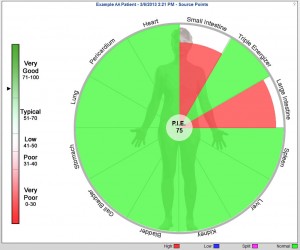
Greetings and best wishes for 2010! What a busy year-end it’s been–and what a great year! 2009 was certainly an exceptional year, and not just in bad ways. I’ll write more about that later, but for today, I’d like to show you a quick case. Take a look at the following PIE Graph: What do you think? Honestly, if someone showed me this PIE without any other information, I’d think, “Hmm. Score is just a... Read more
Falling Down the Stairs

I was in Kansas City last weekend where I taught a module on meridian graphing at the Acupuncture Society of America. I ran across an interesting case: One of the students in attendance at the seminar had slipped the night before and fallen down some stairs onto concrete. She landed on her right side and noted that she had pain in her right hip and the right side of her back, as well as her... Read more

Ears Follow Up

Editor’s Note: This article was originally published in 2009. The Auriculo 3D software referenced here is now Auriculo 360. The clinical techniques described remain fully applicable. Just a quick note to thank everyone who downloaded Auriculo and provided feedback. We got lots of great ideas and input, and we’ll be implementing the best ones to make Auriculo even better. I’ll keep you posted when the next version is available. Meanwhile, thanks for all you do... Read more

ISO 13485

Editor’s Note: This post was written for a previous version of AcuGraph. The current version is AcuGraph CS. The clinical concepts discussed remain applicable. In November 2009, Miridia Technology was awarded ISO 13485 certification for our quality management system. This exclusive certification applies to medical device manufacturers and ensures proper quality standards are met in planning, development, and manufacturing of medical devices. Related Reading The Graph Doesn’t Lie… But Are You Telling the Whole Story?... Read more

Tonification Squared

Today I’d like to address a question I’m often asked about the appropriate way to needle the acupuncture points that are suggested by the AcuGraph system. If you don’t use needles in your practice, this information is equally applicable to laser, electricity, or whatever treatment modality you use. The question usually is phrased something like this: “How do I know which points to tonify and which points to sedate?” or “I understand that I should... Read more

Auriculo Software

Editor’s Note: This post was written for a previous version of AcuGraph. The current version is AcuGraph CS. The clinical concepts discussed remain applicable. In October 2009 we released Auriculo for iPhone, iPod and PC. This reference software brings the resources of many textbooks together into one convenient application. Simply look up the condition you want to treat and instantly see the auricular points to address the problem. Related Reading The Graph Doesn’t Lie… But... Read more

Another New Facility

Editor’s Note: This post was written for a previous version of AcuGraph. The current version is AcuGraph CS. The clinical concepts discussed remain applicable. In September 2009, Miridia Technology Inc. relocated to our new facility in Meridian, Idaho. Featuring a warehouse, classroom space, research lab and much more office space, the new building should serve our needs for years to come. Related Reading The Graph Doesn’t Lie… But Are You Telling the Whole Story? The... Read more

Losing it All

This week I’m writing from a foreign country. Or at least it feels that way. I’m writing from a foreign computer, which is like a whole different world. I feel completely displaced, somewhat ignorant, and definitely alien. I probably deserve this exile, but I’m glad to know it’s only temporary. You see, I’ve written and spoken literally for years about the need for secure backup of computer records. I’ve continually offered our customers pearls of... Read more

A Sense of Proportion

Question: What’s the difference between the two graphs below? The answer may be a little more complicated than it first appears. As you can see, both of these graphs have exactly the same values for every meridian. In fact, both of these graphs were produced from the same exam. But one shows all meridians in the normal range, and the other shows a deficient Small Intestine and a split Large Intestine. What gives? The answer... Read more

How Much? How Often?

Today’s blog entry is really more of a mini-survey. Let me explain. As professionals, we all tend to gauge our equipment investments based on the potential return on those investment. We buy new equipment, take training courses, select our office location and furnishings, and pretty much make most business decisions based on the bottom line. And this is as it should be. Can I make more money if I do, or learn, or purchase the... Read more

TCM, AcuGraph and Herbs

Editor’s Note: This post references AcuGraph 3, which has been succeeded by AcuGraph CS and AcuHerb, which is no longer available. The clinical concepts discussed remain applicable to current practice. We get lots of questions about TCM interpretations of AcuGraph results. TCM practitioners are sometimes confused about how to interpret graph findings that don’t *seem* to agree with their TCM training. One common example is Spleen Excess. What do you do when you see an... Read more

AcuHerb Herb-Drug Interactions

After months of exhaustive research we released a new and improved AcuHerb module for AcuGraph including a built-in catalog, automatic ordering, and an instant reference of  Pharmaceutical interactions for Chinese herbal formulas. It was yet another first; prior to this release, there was no herbal-pharmaceutical interaction software available. Read more

AcuGraph Multi-Connect

In May 2008, we released AcuGraph Multi-Connect Network version–the world’s first networkable meridian graphing software. This tool allows users to network multiple AcuGraph installations to share the same data. Larger clinics can now offer AcuGraph exams in multiple treatment rooms at the same time. Related Reading AcuGraph II Released AcuGraph 1.0 Released Worldwide AcuGraph Research Project Read more

AcuGraph 3 Release

January 30, 2008 brought the release of AcuGraph 3. This massive update revolutionized acupuncture practice once again with numerous new innovations including the following: PIE Chart Screening Module Speaking Exam Maximize Windows WHO Abbreviation Standard Interactive Help HIPAA Compliant Robust Notes Complete Patient Info Energy Cycle Graph Expert Reference Section Emotional Imbalance Correlation AcuHerb Integration Full Printing, with PDF Digital Integration Read more