Editor’s Note: This article was originally published in 2015. The Stimplus Pro referenced here has been succeeded by the Pointoselect Digital, and Auriculo 3D is now Auriculo 360. The clinical techniques described remain fully applicable.
Have you experienced the death of a patient?
It hurts.
You’ve shared part of my journey with a special patient in previous blogs.
We cried together when she was diagnosed with Pancreatic Cancer in January of 2011. They gave her six months to live. (Complementary versus Alternative)
She and I worked together with her oncology team. They worked on fighting the cancer. She worked on good nutrition and maintaining a healing lifestyle. I worked on helping to balance her meridians through the process. (Surviving Chemotherapy)
She was a wonderful lady and I was blessed to serve her until the end.
*****
It’s a hard subject.
Birth and death are two things we all have to experience in this earthly existence.
While in college, I had the opportunity to intern at San Diego Hospice. There were many who chose not to take this internship, simply because they were afraid. I’ll admit, I was a bit hesitant at first, but I’d never trade my hospice internship experience. I learned SO much.
Are you comfortable treating patients who are dying?
In today’s blog, I’ll share some helpful acupuncture strategies relating to chemotherapy and end of life symptoms I learned while interning in San Diego with an amazing supervisor, Erin Raskin, L.Ac..
I keep this information tucked safely in a file so I can refer to it as needed.
Each time a hospice patient shows up in my clinic, I’m glad I have it. Maybe some of my clinical resources will be helpful to you too.
ROOT: Organizing Energy
The body is amazing. I learned through my hospice experience that energy needs to be “organized” in order for the patient to comfortably let go during the dying process.
A lot of our hospice treatments involved creating order so the body could shut down comfortably. (I’ll be writing another blog about this soon.)
I’ve found AcuGraph to be very valuable for end-of-life treatment strategies. The graphs typically change quite often as the body transitions.
My approach is always to first treat the imbalances, and then deal specifically with symptom relief.
Patients and family members appreciate seeing and understanding my approach to treatment.
BRANCH: Symptom Relief
Nausea
Pericardium 6 is regulatory, so test it first and see if it helps or makes things worse. If it helps it’s great, but often it makes symptoms of nausea worse.
Tui Na (or massage) up the Spleen and down the Stomach channel.
Anchor qi at the feet via the Ba Xie points.
Spleen 9 and Shen Guan, which is an extra point 1.5 cun distal to Spleen 9.
Massage DOWN the back from the thoracic spine to the sacrum. (Do NOT rub up and down.)
Constipation
Constipation causes a lot of unnecessary pain. I’ve seen patients who would be allowed to leave the hospice facility and go home IF they could have a bowel movement.
Rub the belly clockwise, in the direction of the bowel.
If they are still eating, try chia seeds in water which turn to gel.
If ambulatory, get them moving safely and often.
Triple Energizer 6, Kidney 6, Stomach 37.
Auricular: Constipation area.
Edema
This is because fluids and lymph are not moving.
Massage the limbs towards the groin and the armpits.
Treat any tender points along the Triple Energizer and the Spleen channels. Favorites of mine are TE 6 along with SP 6, 7, 8 and 9.
Pain from a Tumor
When a patient decides to accept end-of-life care, mechanisms such as chemotherapy and radiation to decrease the size of the tumor are typically suspended. Often the size of the tumor will increase quickly, causing pain.
Figure out which meridian is related to the pain. Treat the Xi Cleft or the Shu Stream points for that meridian.
Auricular: Brain for pain, Sympathetic Autonomic Point, Point Zero, and any ashi areas such as the lumbar spine, abdomen, pancreas, thoracic spine, cervical spine, etc.
Fear and Anxiety
Yin Tang to calm the mind.
Then add Shen Men and choose the following ear points according to the predominant emotion…
Fear: Kidney
Anxiety, Worry, Over-thinking: Spleen
Anxiety, Mania: Heart
Massage.
Music, singing therapy, art therapy, pet therapy.
Aromatherapy: Lavender, Rose.
All and/or MOST of the Above Symptoms
Left ear: Kidney, Spleen, Triple Energizer.
Right ear: Pericardium or Heart, Stomach.
*****
You never know when you will need to help a patient transition through end-of-life care. The most important thing to remember is this:
Don’t be AFRAID. It can actually be a beautiful experience.
Honestly, my hospice patients taught me just as much about life as they did about dying…
With that, I’ll have to leave you looking forward to Part II!
I’ve got a couple more blogs to write on this subject, .
Make sure you share your hospice/end-of-life clinical experiences in the comment section below, so we can all learn from each other.
If you want to learn more about how AcuGraph helps patients and their loved ones understand your treatments – click here!
Regardless of who we are, where we live, and what our life experiences may be—there are two things everyone of us are guaranteed to experience: birth and death. Acupuncture helps with both.
This section discusses how acupuncturists can help terminally ill patients with advanced cancer as they decline toward death.
First, let’s talk about some general information about the stages of death you should be aware of.
I was blessed to learn a lot about the dying process through my experience interning at hospice while attending school at Pacific College of Oriental Medicine, San Diego. I’ll share a few thoughts here, but I’d suggest you take the time to familiarize yourself with this process at a deeper level. If you Google search “Stages of Death” and focus your reading on hospice websites, there is a lot of really helpful information to get you started.
Although every patient’s circumstances will be somewhat unique, there are general commonalities to be expected in the dying process.
The PHYSICAL Process of Death
The patient will most often experience an “orderly process” of physical changes in which systems of the body will progressively shut down.
Heart
As the heart shuts down, blood doesn’t pump normally. The arms and legs feel cool because blood isn’t reaching the limbs. Limbs may become purplish and/or blotchy because when blood isn’t pumping at full capacity, it pools at the joints.
Kidney
Less blood going to the kidneys leads to a lack of kidney function. At first, the patient will experience a decrease in urine flow. With a decreased flow of urine, toxins accumulate–leading to dark and/or bloody urine. As the kidneys stop working the patient ceases to urinate.
Brain
Loss of blood to the brain and chemical imbalances as the organs shut down contribute to mental changes such as disorientation, confusion, agitation, and the inability to recognize family members. Often patients experience hallucinations as well.
Lung
Breathing may become irregular and labored. It is normal as the lungs shut down to notice long breaths followed by shallow ones. The patient may stop breathing for a short time and start back up again. Fluid accumulating in the lungs leads to congestion and gurgling, which is often described as the “death rattle.”
*The death rattle is a common term used in the hospital to describe the sound of fluid accumulating in the lung and throat at the end of life.
Digestive
As the body slows down it is less able to use nutrients and fluids, which leads to a loss of appetite.Sometimes drugs the patient is taking for pain will lead to nausea, vomiting, and loss of appetite. Tumors and fluid accumulation also alter digestive function.
Within the process of shutting down, the patient experiences general overall weakness and fatigue, which progressively lead to symptoms such as increased sleep, loss of bladder and bowel control, and even coma. Yet, at the very end—it is common for the patient to experience an uncharacteristic burst of energy. Family members who are not aware of this phenomenon may be surprised when the patient suddenly wants to talk and eat. This is a great blessing and should be recognized as an opportunity to say final goodbyes.
The EMOTIONAL and SPIRITUAL Process of Death
The emotional and spiritual aspect of shutting down is different for each patient. Sometimes a person is emotionally, spiritually and mentally resolved to let go, but the body hasn’t finished its natural shutting-down process. All you can do is wait and offer comfort. Other times the patient has mental and emotional work to do before they are ready to let go, which also involves waiting–but acupuncture is really great during this transition.
It was an eye-opening experience for me to learn that not everyone dies by peacefully falling asleep. Although it isn’t easy to accept, it is important to understand. Some patients experience an easy transition to death, while others experience agitation, distress, and irritation known as “terminal restlessness.”
*Terminal restlessness is a condition where instead of experiencing a peaceful transition to death, the patient becomes agitated, distressed and irritated within the final stages of dying. It is unpleasant for the patient and their loved ones to watch and experience.
While I was a student, experienced hospice care workers explained that there are multiple theories behind “terminal restlessness:”
Theory #1: Chemicals
The biological effects of chemical toxicity build up, metabolic changes, pain, and urinary or fecal retention—lead to a distressful dying process. Some patients have had more toxicity introduced into their system through the cancer experience. The solution is sedation, drugs for pain, and proactive treatment to avoid bowel impaction and urinary blockages.
Theory #2: Attentive Care
Patients who do not feel emotionally and/or physically safe and taken care of during the dying process experience terminal restlessness. Whereas those who feel their needs are met are more relaxed and prepared for death, thus experience an easier transition. The solution is attentive care.
Theory #3: Emotions
Life experiences and disappointment leading to anger, fear of death and spiritual distress. One solution is to offer sedation drugs to calm the patient. If the patient has spiritual awareness, prayer and someone to offer religious support is helpful.
The fact that there are multiple perspectives to consider as to WHY some die peacefully and others experience distress is helpful to consider. It doesn’t change the fact that either scenario can happen, but it does give us some insight into how best to care for the patient, especially from an acupuncture perspective.
Hospice Workers LOVE Acupuncturists
Hospice care providers are ALWAYS overjoyed when it’s Acupuncture Day at Hospice—especially on a day when they have patients suffering from “Terminal Restlessness.” Although the staff doesn’t quite understand HOW we treat, they recognize the amazing changes that occur in their distressed patients.
This is just one more reason it’s awesome to be an acupuncturist! We’re great at treating agitation, distress, and irritation—regardless of their source.
Treatment Tips
Make sure you have extra resources besides needles. Sometimes an agitated person thrashes around and needles just won’t work. Besides using my fingers, here are a couple of EXTRA items I always bring with me.
Press Tacks:
Tacks are great. I like to put tacks on important calming points. They are also great because if you leave them on after treatment, loved ones can simply touch the tacks with their finger to activate them again later.
Stimplus Pro:
If you are visiting a patient in the hospital, you might have to follow “rules” that prohibit you from using needles. If you have a Stimplus Pro you can treat any point on the body and ear.
Treatment Strategies
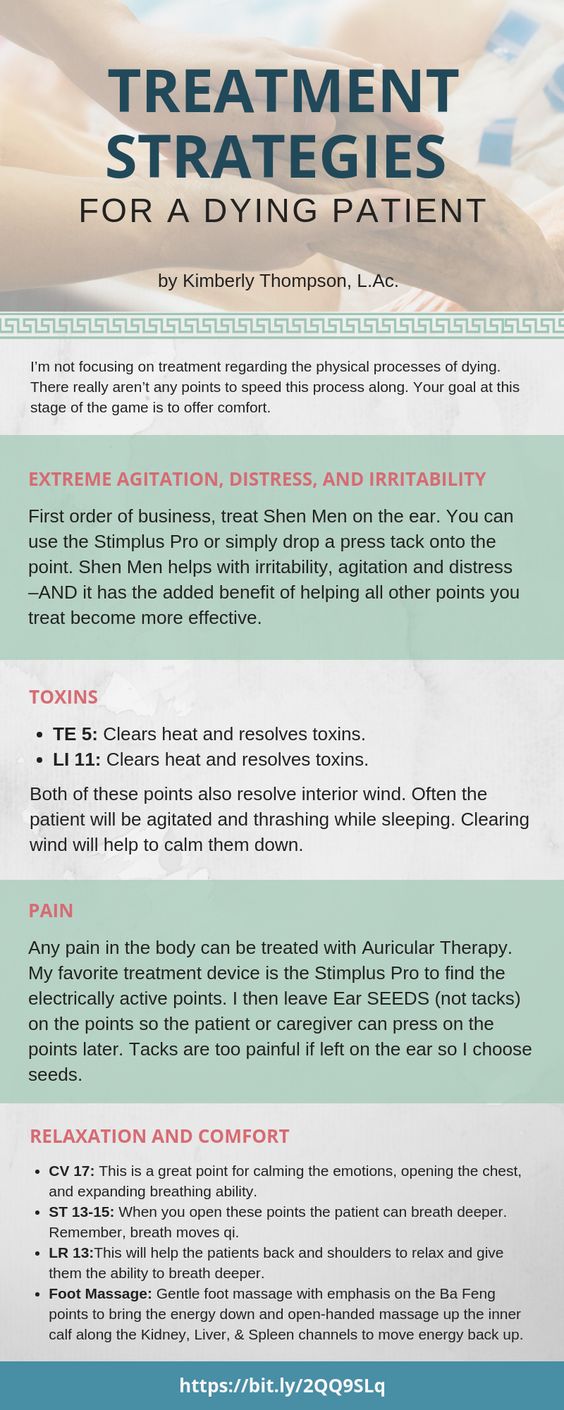
You’ll notice I’m not focusing on treatment regarding the physical processes of dying. There really aren’t any points to speed this process along. It just depends upon how strong the patient’s constitution is. Your goal at this stage of the game is to offer comfort.
Extreme Agitation, Distress, and Irritability
First order of business, treat Shen Men on the ear. You can use the Stimplus Pro or simply drop a press tack onto the point. Shen Men helps with irritability, agitation and distress–AND it has the added benefit of helping all other points you treat become more effective.
I also like to treat the Jing Well points on both the hands and feet with the Stimplus Pro at 20 Hz for 15-20 seconds per point. The Jing Well points work well for multiple reasons.
1) They are easy to get to.
2) They are excellent for agitation and mania because they clear extreme heat.
3) They bring FAST results.
Bonus: Jing Well points also are great for pain anywhere along the channel because the greatest concentration of qi accumulates there. Often, the Jing Well point is enough to stop pain immediately.
Toxins
TE 5: Clears heat and resolves toxins.
LI 11: Clears heat and resolves toxins.
Both of these points also resolve interior wind. Often the patient will be agitated and thrashing while sleeping. Clearing wind will help to calm them down.
Pain
In my last blog I taught about treating “Pain from a Tumor“ via Auricular Therapy. Any pain in the body can be treated with Auricular Therapy.
Here are two charts I like to have on hand as a guide for helping me resolve pain quickly. My favorite treatment device is the Stimplus Pro to find the electrically active points. I then leave Ear SEEDS (not tacks) on the points so the patient or caregiver can press on the points later. Tacks are too painful if left on the ear so I choose seeds.
Relaxation and Comfort
I like to spend time using my hands to feel for blockages. Your hands are the most comforting tool you have. Here are some favorite points I like to manipulate to help the patient relax and calm down.
CV 17: The Lung, the Pericardium and the Heart channels cross here. This is a great point for calming the emotions, opening the chest, and expanding breathing ability.
ST 13-15: Feel to see if the patient is blocked in this area. If they are, go down and open up ST 44. Once ST 44 is open you’ll find the chest opens as well. This is important. Anxiety and fear are held in the chest. When you open these points the patient can breath deeper. Remember, breath moves qi.
LR 13: Use gentle pressure here. Liver 13 is the front Mu of the Spleen and it also moves Liver Qi. This will help the patients back and shoulders to relax and give them the ability to breath deeper.
Foot Massage: Gentle foot massage with emphasis on the Ba Feng points to bring the energy down and open-handed massage up the inner calf along the Kidney, Liver, and Spleen channels to move energy back up.
What’s NEXT?
I hope you’re finding this series helpful.
Once you’ve treated a patient who is suffering from “Terminal Restlessness,” you’ll never forget watching the transformation as they move from suffering to peace. It is truly a beautiful experience.
Death is hard enough for everyone involved. There’s no need for such anguish.
I have one more blog post in this series on death which involves helping a patient who is having a hard time “letting go.”
You’ll be excited to learn about an amazing protocol I have to share called: “TheRainbowTreatment.”
Dr. Kimberly Thompson, DACM, L.Ac., is a seasoned acupuncturist, passionate educator, and trusted mentor. Known for her empowering and down-to-earth approach, she helps practitioners bridge the gap between ancient wisdom and modern tools—especially when it comes to patient communication and clinic confidence.
Healer. Teacher. Mentor. That’s the Dr. Kimberly Way.
View all posts by Dr. Kimberly Thompson, DACM, L.Ac.
One Reply to “Death and Dying: An Acupuncturist’s Perspective”









One Reply to “Death and Dying: An Acupuncturist’s Perspective”